
Blind Accessible Scripture
Halakhah (Jewish law) requires public readings from a Torah scroll every Monday, Thursday, Saturday, New Moon, and holiday, as well as from a megillah twice every Purim. This canting must be done from a kosher scroll. One may not rely on a printed text or on memory. This requirement puts blind Jews in a difficult position: while many have the skills to cant from a Braille text or from memory, the validity of such readings is not always accepted.
This pain point of our community demands of Jews to use our utmost halakhic ingenuity towards solutions for accessibility. In response to a request by the blind Jewish community, the Kedusha Project has developed kosher scrolls that can be read in a tactile way.
Many attempts had already been made to include blind readers in the Torah service. In 2003, The Committee on Jewish Law and Standards of the Rabbinical Assembly published a responsum permitting readings by blind Jews in a few limited circumstances. While that ruling helped to create an opening for expanding access, its scope is limited, and its underlying implication is that such readings aren’t truly valid as a way to fulfill the community’s obligation. Fifteen years later, in the wake of her blind son’s bar mitzvah, Aliza Sperling argued that readings from a Braille chumash (non-ritual copy of the Torah) could and should be allowed, while acknowledging that such a position required significant halakhic leniency. In 2021, the Devarim Institute created a set of scrolls in Hebrew Braille. These scrolls have proven extremely valuable for readers of Hebrew Braille, and they share many of the features of traditional Torah scrolls, such as the use of parchment and rollers. Other important features, such as the use of Ashuri Hebrew script (the technical term for letters that look like אבג) written in black ink, were not yet achieved in a blind-accessible scroll.
The challenges were considerable. In the first place, Ashuri letters come in different sizes, whereas the Braille letter cell must not vary in its dimensions. Additionally, a kosher tactile reading would require the reader to feel the ink of the scroll—not simply Braille that is adjacent to the ink. Finally, Torah scrolls must be created by writing. Braille is ordinarily created by embossing, a prohibited manner of creating letters in a Torah.
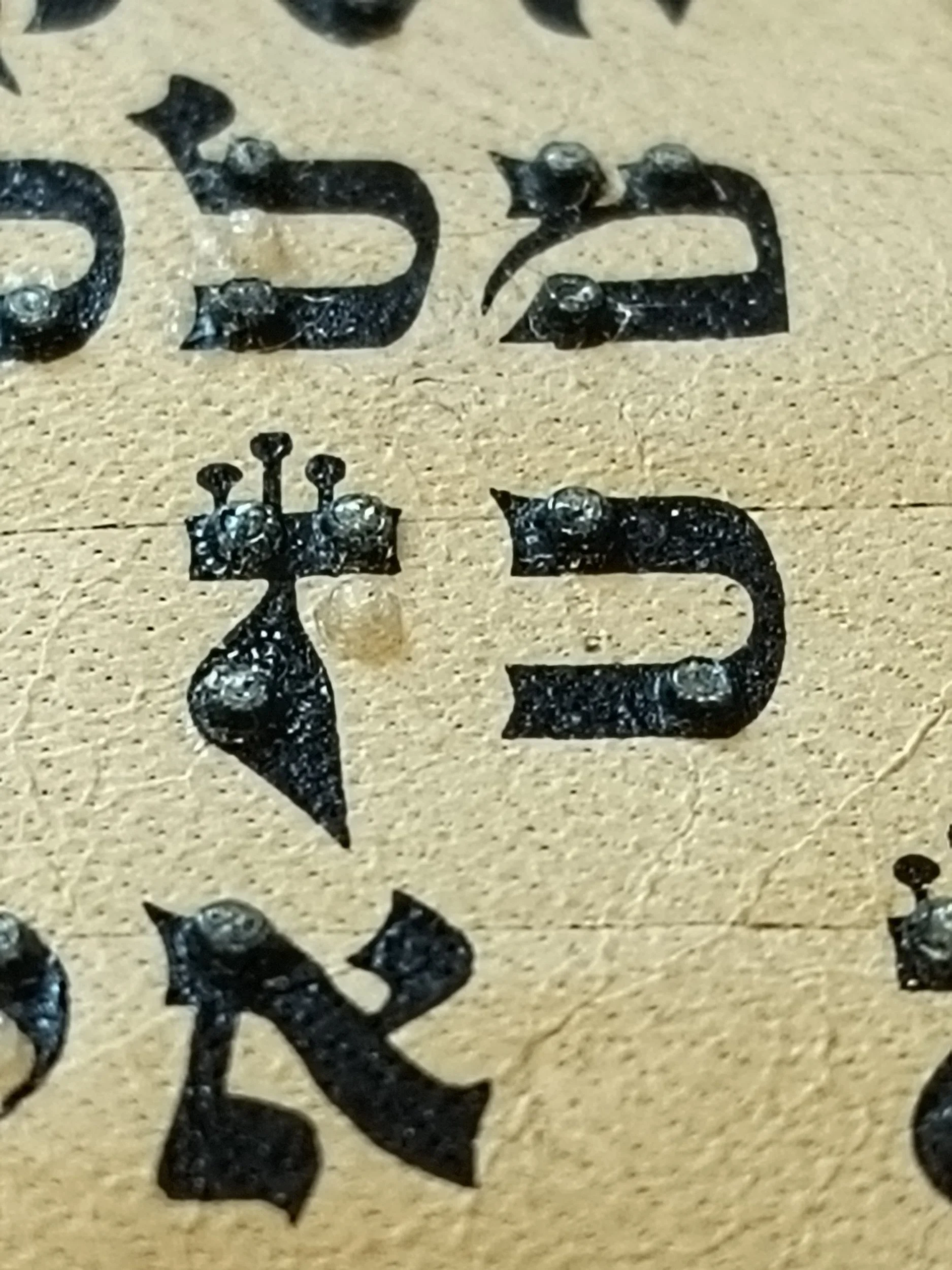
To thread this challenging needle, the Kedusha Project developed a method to overlay tactile letters directly atop scribed letters. In the picture above, you can see a few letters. The underlying Ashuri script was screen printed by hand, according to the method of Rabbi Yitchak Abadi. The Braille letters were screen printed in black or clear acrylic (note the two different colors of dots present). If the tactile letters are black, they qualify halakhically as ink; and because they are fixed above existing writing, they take on the status of the underlying text through the principle of ketav al gabei ketav. If they are not black, the law considers them as if they do not exist at all. In this way, the blind reader would not be reading letters that merely represent a Torah scroll, but the letters of a kosher Torah scroll themselves--accessible by touch rather than by sight. This innovation has required the development of a novel script so that each Braille dot register properly relative to the Ashuri letter.
Such scrolls are readable by blind and sighted readers alike. And while the letters may look odd to sighted readers, perhaps that is a feature hidden in the workable halakhic system Gd has given to us. If these scrolls can provide sighted Jews insight into the nature of Braille systems, wouldn’t that be a lovely gift of wisdom from our Torah?